Every Diwali season, cinema lights up the country just as much as diyas and crackers. But 2025 is different. For the first time in years, three of India’s biggest industries — Tamil, Telugu, and Hindi — are colliding creatively and commercially within the same window. The result is not merely a set of film releases, but a mirror of where Indian cinema stands today: ambitious, interconnected, experimental, and impatient to break its own boundaries.
Let’s take a look across the map — from Chennai to Hyderabad to Mumbai — to understand how this festive season has turned into a multi-language cinematic marathon.
Tamil Cinema: Four Films, One Battle — The Diwali Face-Off
Tamil cinema leads this year’s Diwali rush with an unprecedented four-way clash. On October 17, four films representing entirely different sensibilities will go head-to-head — Bison: Kaalamaadan, Dude, Diesel, and Kambi Katna Kathai.
Bison: Kaalamaadan — The Prestigious Contender
Directed by Mari Selvaraj, the social-sports drama Bison has generated immense anticipation. Starring Dhruv Vikram, the film promises a visceral exploration of caste, power, and identity through the lens of bull-taming and rural sport. Selvaraj, known for Pariyerum Perumal and Karnan, once again dives into the socio-political heartland of Tamil Nadu — this time blending it with the adrenaline of competition. Early festival reviews suggest that Bison might set the critical tone of the season.
Dude — The Millennial Voice
Dude, starring Pradeep Ranganathan, takes the opposite route — a youth-centric romantic comedy-drama filled with self-referential humor and modern relationship dilemmas. After Love Today’s success, Pradeep’s return as actor-director has drawn high curiosity. The film targets the urban multiplex crowd, riding on relatability, music, and meta-humor.
Diesel — The Mass Engine
For audiences craving raw action, Harish Kalyan’s Diesel delivers high-octane energy. With Athulya Ravi in a key role, it’s a full-throttle commercial entertainer — guns, chases, betrayal, and revenge packaged in a festival format. The bilingual Tamil-Telugu release also ensures a wider reach across southern markets.
Kambi Katna Kathai — The Wild Card
The fourth film, Kambi Katna Kathai, starring Natty (Natraj), brings comedy and chaos. Centered around a con artist’s misadventures, it offers tonal relief amid the heavy competition. Sometimes, in festival windows, laughter can be the most profitable genre.
Together, these four films form the backbone of Tamil cinema’s Diwali. But their significance extends beyond box office numbers — they embody the diversity of Tamil storytelling. Whether Bison’s social realism or Diesel’s mass formula, the common thread is ambition. And ambition, this year, seems to be the national language of cinema.
Tollywood’s Big Moves: Sequels, Strategy, and Cross-Market Vision
While Tamil Nadu gears up for its domestic derby, Telugu cinema is scripting its own festival saga — not through immediate clashes, but long-term positioning and policy innovation.
Akhanda 2: Thaandavam — The Franchise Fire Returns
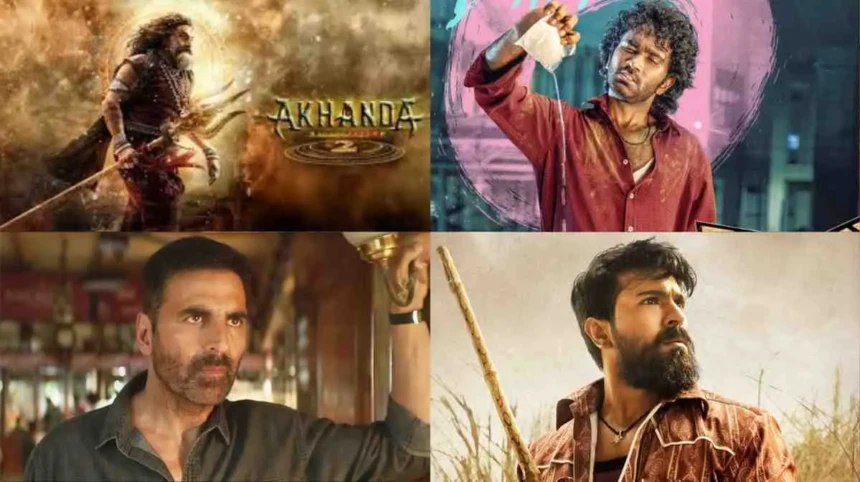
Among Telugu’s most talked-about developments is the confirmation of Akhanda 2, starring Nandamuri Balakrishna and directed by Boyapati Sreenu. The original Akhanda became a mass phenomenon in 2021, redefining the “divine hero” template. Its sequel, officially slated for December 2025, has already sparked countdown campaigns and fan rituals. By choosing a post-Diwali release, the producers smartly avoid overcrowding while keeping momentum alive. The hype also reinforces Tollywood’s growing mastery of franchise building — a model once monopolized by Bollywood.
Ram Charan’s RC17 with Sukumar — The Power Combo
Another seismic development: Ram Charan’s upcoming collaboration with director Sukumar. Tentatively titled RC17, the project follows Charan’s ongoing Peddi. Given Sukumar’s visionary success with Pushpa, expectations are sky-high. Insiders suggest the duo aims for a gritty socio-commercial drama with pan-India scale, fusing Sukumar’s layered writing with Charan’s star charisma.
Jatadhara — The Bilingual Bridge
Meanwhile, Jatadhara — starring Sonakshi Sinha and produced as a bilingual in Telugu and Hindi — is targeting a November 7 2025 release. The motion poster and trailer, unveiled by superstar Mahesh Babu, highlight a mythological-mystery theme set against modern backdrops. This bilingual model underscores how Telugu cinema now sees the Hindi belt not as a dubbing afterthought but as a simultaneous market.
Policy Boost: Telangana Opens Its Forests
Beyond the soundstage, the Telangana government has rolled out a new policy allowing film shoots in over 70 forest locations with single-window approval within 24 hours. This bureaucratic streamlining could transform the region into a visual playground for filmmakers, particularly those seeking authentic rural or ecological backdrops. With more Telugu, Tamil, and Hindi productions choosing Hyderabad as a base, such steps position Telangana as a future film-shoot hub.
The Box Office Reality Check
Despite enthusiasm, Tollywood remains grounded in numbers. Recent Koimoi analyses show how quickly audiences reject formulaic fare. Every release — from mid-budget romances to grand spectacles — is under constant scrutiny. In October alone, the Telugu calendar lists Diesel (Tamil-Telugu bilingual), Telusu Kada, K-Ramp, and The Girlfriend. Each competes for limited screens and limited patience.
The pattern is clear: content that connects beyond its region survives; the rest vanishes within days.
Bollywood: Risk, Reinvention, and Remakes
Moving north, Bollywood is also in transition. After a mixed 2024 where a handful of hits coexisted with major flops, Hindi cinema’s 2025 lineup shows both humility and hunger.
Sankranthiki Vasthunam — A Telugu Soul in Hindi Clothes
The most symbolic project of this cross-industry era is Sankranthiki Vasthunam, the Hindi remake of a recent Telugu crime entertainer. Starring Akshay Kumar and directed by Anees Bazmee, the remake adapts the moral triangle of the original into a Mumbai setting. The move reinforces Bollywood’s new pragmatic phase — where remakes aren’t just translations, but collaborations across storytelling cultures. For Akshay, whose recent films have struggled, this could be both a reset and a risk.
Ek Deewane Ki Deewaniyat — Romance Reignited
Set to release on October 21, just days after the Tamil Diwali slate, this romantic drama featuring Harshvardhan Rane and Sonam Bajwa aims to revive the emotional, melodic Bollywood formula that once ruled the box office. Positioned as a counter-programming alternative to action-heavy southern films, it targets families and couples looking for warmth after the fireworks.
Lord Curzon Ki Haveli — The Offbeat Whisper
Released on October 10, Lord Curzon Ki Haveli — starring Arjun Mathur and Rasika Dugal — quietly made its mark as a darkly comic thriller. Critics praised its sharp dialogue and atmospheric tone. The film’s modest success hints at a refreshing truth: smaller, genre-specific projects are finally finding theatrical oxygen again.
Deva — Lessons from a Missed Opportunity
Earlier in 2025, Deva, starring Shahid Kapoor, proved that remakes can’t rely solely on pedigree. Adapted from the Malayalam hit Mumbai Police, the film earned praise for acting and cinematography but suffered from weak writing. Its middling box office reinforced what audiences now demand — authenticity over replication.
Chhaava — The New Benchmark
If one Hindi film defined success in 2025, it’s Chhaava. The historical epic stunned analysts by crossing ₹300 crore and achieving over 12× returns within days. Its triumph showed that scale, rootedness, and emotional conviction still command theatrical glory. In an era obsessed with algorithms, Chhaava proved that heart and history can still draw crowds.
Cross-Industry Currents: One Audience, Many Languages
The most fascinating story of 2025 isn’t individual films — it’s convergence.
1. Festival Clustering Across Languages
Tamil’s Diwali lineup on October 17 overlaps with Telugu’s mid-month releases and precedes Bollywood’s Ek Deewane Ki Deewaniyat. Such proximity intensifies competition but also indicates how producers view festivals as pan-Indian events, not regional ones.
2. Shared Talent and Story Ecosystems
Actors, composers, and technicians are increasingly fluid. A Tamil DOP might shoot a Telugu epic; a Telugu story might inspire a Hindi remake; a Bollywood actress headlines a bilingual. Jatadhara epitomizes this — a Hindi star in a Telugu framework, marketed in both languages simultaneously.
3. Rise of the Bilingual Strategy
Earlier, dubbing was post-production. Now, it’s in the script. Producers plan for multiple markets from day one. The Diesel team has openly pitched the film as “Tamil-Telugu made.” The result is a more nationalized but still localized form of storytelling.
4. Streaming as Safety Net and Amplifier
Theatrical success is still the crown, but OTT platforms are the insurance. Even if a film underperforms, its dubbed versions or streaming debut can resurrect reputation. Several 2024 sleepers found cult status on OTT, prompting producers to think multi-window rather than single-weekend.
5. Policy and Infrastructure Support
With Telangana’s new forest-shooting initiative, and Tamil Nadu and Maharashtra pushing film tourism, state governments are recognizing cinema’s economic pull. Ease of shooting translates to faster schedules, lower costs, and more regional employment — a virtuous cycle that benefits the entire ecosystem.
The Audience Equation: Smarter, Sharper, Selective
If there’s one unifying truth across all industries, it’s that the audience has evolved.
They are no longer loyal to a language — only to quality. A Tamil film like Bison can trend in Hyderabad; a Telugu thriller can top Netflix India; a Hindi epic like Chhaava can draw South Indian crowds. The linguistic silos that once defined Indian cinema are crumbling under the weight of curiosity.
However, that same curiosity brings higher expectations. Mediocrity is punished instantly. Social-media verdicts decide box office fate within hours. For producers, this means precision — in storytelling, release timing, and marketing tone. The days of star power guaranteeing success are over; now, content drives the caravan.
Looking Ahead: What Diwali 2025 Symbolizes
So, what does this multi-industry festival season tell us?
- Tamil cinema is flexing diversity — proving that its directors can tell stories ranging from folk realism (Bison) to Gen-Z humor (Dude).
- Telugu cinema is scaling ambition — planning sequels (Akhanda 2), pan-Indian collaborations (Jatadhara), and infrastructure upgrades.
- Bollywood is recalibrating — rediscovering roots (Chhaava), learning humility (Deva), and embracing cultural exchange (Sankranthiki Vasthunam).
All three industries are now part of one conversation. The future of Indian cinema is no longer “Hindi vs South.” It’s “India vs Mediocrity.”
The Verdict Before the Verdict
As lights flicker across cities this Diwali, theaters too will glow — with hope, rivalry, and anticipation.
Will Bison roar loud enough to dominate the festive weekend?
Will Dude connect with the young hearts that made Love Today a cult hit?
Can Diesel’s mass formula cut through competition?
Will Akhanda 2 and Jatadhara push Tollywood’s national footprint even further?
And will Bollywood’s Sankranthiki Vasthunam remind Hindi audiences of the thrill of a tight crime drama?
No one knows. But that’s the magic of this moment — uncertainty wrapped in light.
For decades, Diwali has been a symbol of triumph of good over evil. In 2025, it’s also the triumph of content over complacency. As filmmakers across Chennai, Hyderabad, and Mumbai prepare to light their creative lamps, one truth shines clear: Indian cinema’s best festival is not behind it — it’s just beginning.