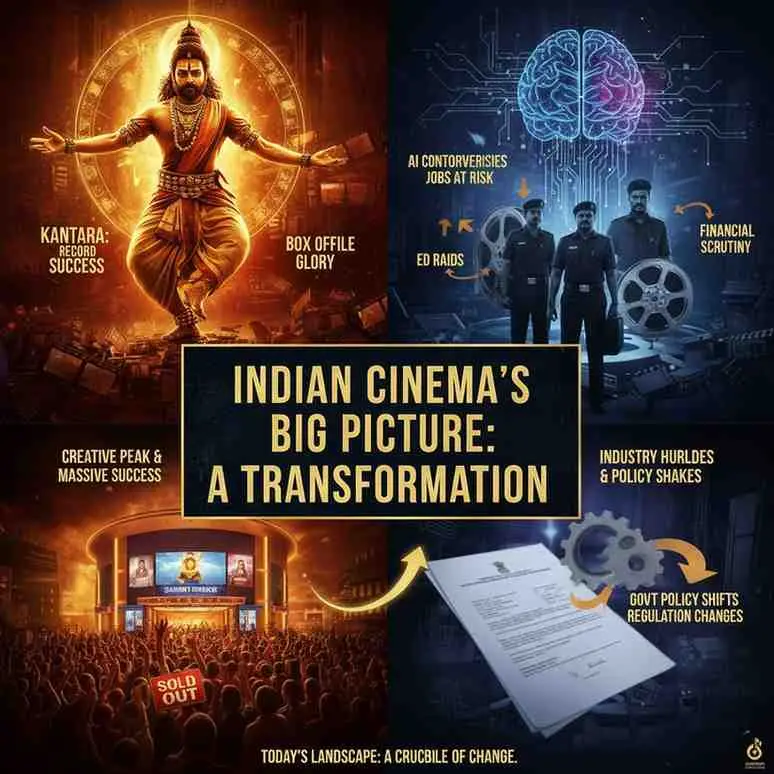
Indian cinema is in the midst of a fascinating moment of transformation. From record-shattering blockbusters to government policy pushes, and from the growing influence of regional industries to legal battles around AI-generated content, the entertainment landscape is both turbulent and exhilarating. Today’s top film headlines highlight not just isolated stories, but interconnected shifts that will shape the future of how India makes, consumes, and regulates its cinema.
This article brings together the biggest trending developments: the phenomenal rise of Kantara: A Legend Chapter 1, the brewing controversy around AI videos, enforcement scrutiny of superstar Mammootty, new government initiatives to turn India into a global media hub, and the continued surge of South Indian cinema on the national stage. Together, they paint a picture of an industry at once celebrating its creative triumphs while grappling with technological, financial, and cultural challenges.
Kantara: A Legend Chapter 1 – A Regional Story with National Power
The most electrifying news dominating the entertainment press is the runaway success of Kantara: A Legend Chapter 1, directed by and starring Rishab Shetty. In just five days, the film crossed the ₹250 crore mark domestically, surpassing even Pushpa: The Rise’s lifetime collections. According to trade trackers, it has now become the fourth biggest grosser of 2025, overtaking even the much-hyped Mahavatar Narsimha.
What makes Kantara’s rise noteworthy is its rootedness in Kannada culture. Much like the original Kantara (2022), the film draws heavily from local folklore, rituals, and spiritual themes. Yet it has traveled beyond Karnataka’s linguistic boundaries to capture the imagination of audiences across India. The pan-Indian release strategy—dubbed versions in Hindi, Telugu, Tamil, and Malayalam—was supported by word-of-mouth buzz and strong critical reception.
This reflects a key industry trend: regional cinema as national cinema. Films like Baahubali, KGF, Pushpa, and now Kantara Chapter 1 prove that authenticity can travel farther than generic formulas. Audiences are increasingly open to subtitles and dubbed releases, prioritizing engaging stories over star power or traditional Bollywood dominance.
But what makes Kantara even more compelling is its cultural commentary. At a time when Indian society debates its connections with tradition, spirituality, and modernity, the film taps into a desire for rooted storytelling. This resonance, combined with Rishab Shetty’s uncompromising creative vision, is why box office numbers keep climbing.
AI Content Crisis: Bollywood Battles Its Digital Doppelgängers
While Rishab Shetty was celebrating success, Bollywood faced a storm of a very different kind. After a Reuters investigation, hundreds of AI-generated Bollywood videos disappeared from YouTube. These videos used synthetic technology to create hyper-realistic simulations of actors in fabricated scenarios—sometimes lighthearted, but often misleading or exploitative.
Among the most affected were stars like Abhishek Bachchan and Aishwarya Rai Bachchan, whose AI doppelgängers appeared in clips that went viral. The actors, deeply concerned about misuse of their likeness, have initiated legal action, demanding clearer accountability from platforms.
This controversy is more than gossip; it touches on fundamental questions of digital rights, consent, and copyright. As generative AI tools get more accessible, creators, fans, and even malicious actors can replicate a star’s face or voice with unsettling accuracy. Without robust regulation, the line between genuine content and deepfakes risks blurring—threatening both celebrity reputations and audience trust.
For Bollywood, which thrives on star power, this is an existential issue. The outcome of these lawsuits could set legal precedents, not just for India but globally. Should actors own the exclusive right to their digital image? Should platforms like YouTube be forced to preemptively filter such content? How can AI creativity be balanced with ethical use? These debates are just beginning, but the stakes for India’s entertainment sector are enormous.
Enforcement Heat: Mammootty Under the Scanner
Adding to the drama, another major headline emerged: the Enforcement Directorate (ED) conducted raids at Malayalam superstar Mammootty’s property in Chennai. Reports suggest the raids are linked to investigations around alleged tax irregularities and potential import violations. While details remain under wraps, the news has sent ripples through the South Indian industry.
Mammootty is not only one of Malayalam cinema’s most respected veterans but also a cultural figure with immense goodwill. Yet his name being tied to an ED raid highlights the increasing scrutiny on the financial dealings of film personalities.
In recent years, multiple production houses and stars have faced investigations linked to money laundering, tax evasion, and offshore investments. As the film industry continues to expand its financial footprint—through global collaborations, OTT rights, and cross-border projects—regulators are watching closely.
The broader implication is clear: transparency and compliance are no longer optional for Indian cinema. The days when financial flows in the industry operated in the shadows are ending, replaced by a climate of accountability.
Government & TRAI: Pushing India as a Global Media Hub
In parallel, the government has signaled a strategic ambition: to make India a global leader in media and entertainment. The Ministry of Information & Broadcasting, along with TRAI, announced policy initiatives to bolster the sector’s international competitiveness.
The measures reportedly include:
- Tax and regulatory incentives for film production
- Support for co-productions with international studios
- Strengthening intellectual property frameworks
- Investment in digital infrastructure and content export strategies
India’s entertainment industry is already among the largest in the world in terms of audience size. But the goal now is to move up the value chain—from being a domestic content powerhouse to becoming a global exporter of stories and production services.
This aligns with broader national goals of cultural diplomacy and soft power. Just as Korea leveraged K-pop and dramas to boost its global influence, India wants to use cinema, music, and digital entertainment to project itself internationally. If successful, such policies could attract billions in foreign investment while giving Indian storytellers a bigger global stage.
South Indian Momentum: A Festival of Releases
Even beyond Kantara, South Indian industries are driving much of the buzz this season. In Tamil cinema, Harish Kalyan’s Diesel cleared censor hurdles and is eyeing a Diwali release. Telugu cinema is preparing for a blockbuster festive lineup, including a remastered version of Baahubali: The Epic, along with Mass Jathara and Vrusshabha.
Perhaps most significantly, Pawan Kalyan’s “They Call Him OG” has become one of 2025’s biggest hits, even surpassing Bollywood’s Housefull 5. This is yet another reminder that the Telugu industry’s storytelling, action spectacle, and fan culture are pulling in audiences nationwide.
The festival season, particularly Diwali, has long been a battleground for big releases. But the interesting trend now is how South Indian releases dominate even Hindi-speaking regions. Their marketing sophistication, dubbed versions, and strong fan bases make them formidable competition to traditional Bollywood blockbusters.
A Filmmaker’s Lifestyle Shift: Rishab Shetty Returns to Roots
Adding a more human angle to today’s headlines, reports surfaced that despite Kantara’s massive success, Rishab Shetty has decided to move away from Bengaluru’s urban life to a village setting. He cited a desire for simplicity and reconsideration of his children’s education.
This decision may seem personal, but it resonates with a larger question facing many celebrities: how to balance artistic success with personal well-being. The pressures of celebrity life, urban chaos, and industry demands often create burnout. Shetty’s move is being read as a conscious rejection of excess, and perhaps a statement that true creativity flourishes when rooted in community rather than constant limelight.
Emerging Patterns: What Today’s Headlines Reveal
When seen together, these stories reveal a cinema landscape undergoing multiple transitions at once:
- Regional stories breaking national barriers – Successes like Kantara and They Call Him OG prove India’s audiences are ready for diverse narratives.
- Technological disruption – AI is reshaping how content is created and consumed, but also raising ethical battles.
- Stricter governance and oversight – From ED raids to policy pushes, the state is more active in regulating and shaping the industry.
- Global ambition – India wants not just to entertain its domestic audience but also to stand as a global cultural powerhouse.
- Personal recalibration – Artists like Shetty are reminding us that behind the glitter of cinema lies the search for balance, authenticity, and roots.
Conclusion: A Cinema at the Crossroads
Indian cinema has always thrived on change—from the black-and-white era to the multiplex revolution to the OTT boom. But the changes underway now feel deeper and more structural. Regional industries are rewriting box office logic, technology is forcing legal reinventions, regulators are stepping in firmly, and the government is betting on entertainment as a soft power tool.
In short, the industry is at a crossroads of tradition and transformation. Films like Kantara celebrate folklore, even as AI threatens to distort celebrity images. Stars face both mass adoration and legal scrutiny. The government dreams of global leadership, while filmmakers themselves return to the simplicity of rural life.
This duality—of success and struggle, ambition and introspection—is what makes today’s Indian cinema landscape so compelling. For audiences, it means more exciting stories, greater authenticity, and increasing access to diverse voices. For the industry, it means navigating uncharted waters with creativity, courage, and integrity.
If the trends seen in today’s headlines are any indication, the coming years could well be the most transformative chapter yet in the saga of Indian cinema.