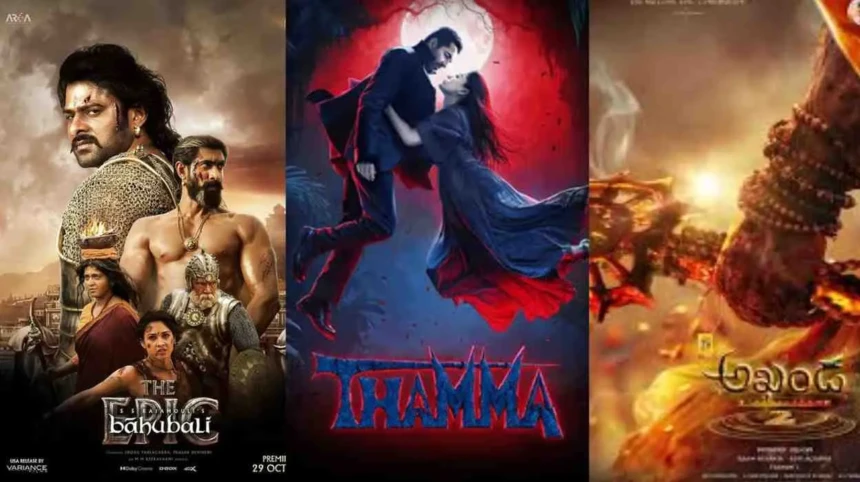
Bollywood’s Festive Triumph: Thamma’s Supernatural Wit
Ayushmann Khurrana and Rashmika Mandanna headline Maddock Films’ latest blockbuster Thamma, directed by Amar Kaushik, the creator behind cult favorites Stree and Bhediya. The film blends horror and humor into a genre that has become India’s most beloved cinematic export after the pandemic — the “supernatural satire.”
With Thamma earning an estimated ₹65 crore in its first four days, it stands as one of 2025’s highest-grossing horror-comedies. The film’s premise — a haunted ancestral home driving a quirky family into comedic confusion — captures both nostalgia and new-age absurdity. Critics have lauded its screenplay for “exorcising social fear with humor,” pointing to how the Maddock Supernatural Universe continues to evolve Indian genre cinema.
Rashmika Mandanna’s performance as a journalist unraveling myths adds energy and freshness, complementing Ayushmann’s trademark satire-driven dialogue delivery. Audiences call it “the festive stress-buster of the season.” It affirms a growing trend: Indian viewers are embracing intelligent comedy with rooted cultural contexts over formulaic romance or hollow thrillers.
Arshad Warsi Confirms Munna Bhai’s Return: Nostalgia Reloaded
Bollywood’s nostalgia quotient surged when Arshad Warsi confirmed the active development of Munna Bhai 3 with Rajkumar Hirani and Sanjay Dutt. Nearly two decades since Lage Raho Munna Bhai inspired moral optimism on screens, the saga of humanity wrapped in hilarity is making a return.
Warsi’s comment — “Munna Bhai is a feeling, not a film” — went viral, echoing a longing for cultural heart within modern cinema’s chaos. The potential addition of social media-age dilemmas to the new script could realign Hirani’s signature moral humor within a contemporary digital world. This revival underlines a powerful shift: legacy characters are being reframed to appeal to millennial nostalgia while introducing them to Gen Z sensibilities.
The Heartbreak of Piyush Pandey’s Passing
But October 2025 wasn’t all celebration. Indian creative industries united to mourn advertising visionary Piyush Pandey. Filmmakers, actors, and ad creators cited his emotional storytelling style as a bridge between advertising and art. Amitabh Bachchan, Shah Rukh Khan, and Akshay Kumar each shared heartfelt tributes, calling him “the invisible director behind India’s imagination.”
Pandey’s knack for scripting empathy into 30-second visuals shaped entire advertising philosophies. His death became a reflective moment for both Bollywood and the ad world, emphasizing how mainstream entertainment still owes its moral compass to creative intellects who understood emotion more than marketing.
Kajol: Quiet Strength Amid Chaos
Adding an artistic counterpoint, actor Jisshu Sengupta recently praised Kajol’s immersive energy during The Trial’s promotions, saying, “Kajol compels brilliance through presence.” Social platforms turned this statement into a conversation about performative dynamism. At a time when star culture dominates, Kajol’s dedication to raw artistry reinforced India’s parallel cinema legacy — where talent, not spectacle, becomes the heartbeat.
Kajol represents an enduring movement in female acting where emotional gravity outweighs glamour. Her influence resonates across industries, reminding young performers to invest not in image, but in introspection.
Akhanda 2: The South Indian Storm
Telugu cinema amplified the country’s festive roar with Akhanda 2’s thunderous teaser unveiling. Nandamuri Balakrishna re-emerges as the fierce Aghora warrior under Boyapati Sreenu’s explosive direction. The visuals — merging folk mysticism with contemporary cinematography — flared across social media within hours. “1000 crore loading…” trended on X, as fans celebrated Balayya’s signature mass persona returning in divine armor.
The teaser positions Akhanda 2 not just as a sequel but as mythology reborn in cinematic fire. Its tone invokes an elemental spirit of Telugu masala films — spirituality entwined with heroism. The combination of chant-driven soundtracks, fiery temple backgrounds, and thunderous monologues can only mean one thing: South Indian cinema continues to lead with vision, volume, and verve.
Tamil Cinema’s Textural Shift
Tamil cinema too has crafted its unique festive footprint with releases like Idli Kadai and the Tamil-dubbed Kantara: The Legend Chapter 1. The state’s creative brigade blends folklore with emotional realism, echoing a hybrid movement — films that appeal to OTT audiences while preserving theater-first traditions. Tamil directors continue to redefine cinematic minimalism, balancing realism against grandeur.
Regional industries today no longer compete with Bollywood — they coexist and often set the aesthetic direction. From Karthik Subbaraj’s genre experiments to Pa. Ranjith’s sociopolitical storytelling, Tamil cinema defines layered, ideology-rich art that stands proudly global yet authentically local.
Baahubali: The Epic – The Return of Cinematic Divinity
Then came the moment that broke the internet — S.S. Rajamouli’s Baahubali: The Epic trailer dropped on October 24, 2025. The trailer presented Prabhas once again as Mahendra and Amarendra Baahubali in a remastered single-film experience that fuses The Beginning (2015) and The Conclusion (2017) into one monumental narrative.
Rajamouli describes this cut as “one soul, one saga, one empire.” Technologically reworked for IMAX, Dolby Vision, and 4DX projection, the film features extended sequences never seen in earlier versions, like Amarendra’s coronation and the hidden war council of Mahishmati.
M.M. Keeravaani’s rescored compositions, with 7.1 Dolby orchestral overhauls, lend emotional continuity to this combined masterpiece. The voice of Sivagami (Ramya Krishna) transcends generations; the trailer closes with her saying, “A kingdom stands tall not on gold or glory, but on sacrifice,” evoking thunderous cheers across theaters and online platforms.
Baahubali: The Epic — A Cultural Resurrection
This edition marks more than a cinematic event; it is a cultural resurrection timed perfectly with the tenth anniversary of Baahubali: The Beginning. The remastered edition promises to remind audiences why Rajamouli’s visual mythology altered India’s filmmaking language.
The launch of Baahubali: The Epic not only revives monumental scale but symbolizes India’s regained dominance in mythic world-building — a lesson global cinema absorbed after RRR’s Oscar triumph. For younger generations, it’s an entry point into mythic grandeur; for veterans, it’s divine nostalgia relived.
Merging modern technology with ancient imagination, Rajamouli alone embodies how Indian storytelling evolved from print mythologies to Hollywood-grade epics. When asked about his motivation, Rajamouli said, “My cinema begins where language ends — it speaks to the soul, not subtitles.” That quote will likely echo through global film schools for decades.
Global Screen Reawakening
Baahubali: The Epic will see pre-release screenings on October 29 in North America before its October 31 worldwide rollout. U.S. distributors have already sold out IMAX marathons. INOX, Cinepolis, and PVR in India confirmed 24-hour screenings. In the United Kingdom, the film achieved the fastest IMAX ticket pre-sales for any Indian release, surpassing RRR’s previous record.
These developments reflect India’s growing influence in the cultural export market. Industry analysts predict that The Epic could become the highest-grossing re-edited project in Indian history — an achievement blending emotion, innovation, and reverence.
The Fusion Trend: Past Meets Present
The connective thread stitching October 2025’s film conversations is fusion — past philosophies reborn through new technology. Films like Thamma and Akhanda 2 prove storytelling is expanding at the intersection of fear and faith. Meanwhile, Baahubali’s mythic resurrection exhibits how franchises can evolve artistically without redundancy.
Key takeaways from this month’s cinematic surge include:
- Heritage Revivals Lead Commercial Cinema: Franchises like Munna Bhai 3 and Baahubali demonstrate that nostalgia fuels revenue as much as novelty.
- Cross-Language Confluence: Regional identities fade as Tamil, Telugu, and Hindi films dominate pan-India conversations equally.
- Faith and Fantasy Merge: Themes of spirituality, supernatural intervention, and moral awakening attract mass audiences in 2025’s emotionally demanding world.
- Performance-Driven Realism Returns: Kajol’s understated brilliance echoes acting’s returning importance amid CGI saturation.
These patterns collectively signal Indian cinema’s maturity — a self-aware medium balancing scale and sincerity.
The Emotional Currency of 2025’s Cinema
What’s particularly remarkable about 2025’s trends is their emotional diversity. Thamma’s satire, Baahubali’s divinity, and Akhanda’s mythic masculinity coalesce into an industry finally achieving balance between intellect and instinct. The shift implies that audiences crave relatability as much as spectacle. Festive releases, instead of being mere revenue generators, have become cultural mirrors reflecting society’s changing values.
Indian cinema today is not about competing for attention; it’s about reclaiming belonging. Whether through laughter in Thamma, faith in Akhanda, or martyrdom in Baahubali, filmmakers are uniting audiences across geographies and generations.
Conclusion: The Kingdom of Stories Endures
As the sun sets on October 2025, India stands witness to an unmatched cinematic renaissance. This month alone embodies everything the industry strives to be: humane, mythic, and magnificently global. The laughter of Thamma, the roar of Akhanda 2, and the grandeur of Baahubali: The Epic converge into one festival of imagination.
Cinema, as this week proves, remains India’s living myth — a realm where spirits, soldiers, and storytellers coexist beyond creed or language. And if one truth defines this decade’s creative spirit, it’s this: even as formats change and technologies evolve, India’s soul will always find its voice through film.
In 2025’s dazzling confluence of laughter, legend, and longing, Indian cinema stands eternal — not merely as entertainment, but as the beating heart of a billion dreams