Indian cinema has always been more than just entertainment—it is a cultural force, an emotional connector, and increasingly, a global phenomenon. On October 9, 2025, the film industry in India witnessed a series of developments that shaped conversations across theaters, OTT platforms, social media, and even political corridors. From box-office triumphs to global collaborations, from censorship clearances to technological controversies, today’s cinematic landscape paints a vivid picture of where Indian cinema stands and where it is heading.
Rishab Shetty’s Kantara: A Legend Chapter 1 – A Cultural & Commercial Storm
The biggest story dominating headlines is undoubtedly the phenomenal success of Rishab Shetty’s Kantara: A Legend Chapter 1. The film, deeply rooted in folklore and cultural mysticism, has become a massive box office winner. Within just its first week, the film crossed the ₹300 crore mark—a staggering achievement that places it among the top earners of the year.
More significantly, the film has outperformed Coolie starring Rajinikanth, securing its place as the third-biggest hit of 2025. For a film that is not powered by Bollywood’s conventional star machinery but by storytelling and regional authenticity, this is a milestone moment.
Rishab Shetty’s vision of blending spirituality, folklore, and high-octane cinematic craft has struck a chord not only with Kannada audiences but pan-India viewers. Critics note that Kantara’s success reflects a broader trend—the rise of rooted narratives that challenge formulaic Bollywood storylines.
Adding to the emotional buzz, post-release celebrations saw Shetty meeting veteran actor Jayaram in Delhi. Their heartfelt camaraderie went viral on social media, symbolizing how Kantara has become more than just a movie—it’s a cultural event.
Dude Gets CBFC Clearance: A New Pan-Indian Challenger
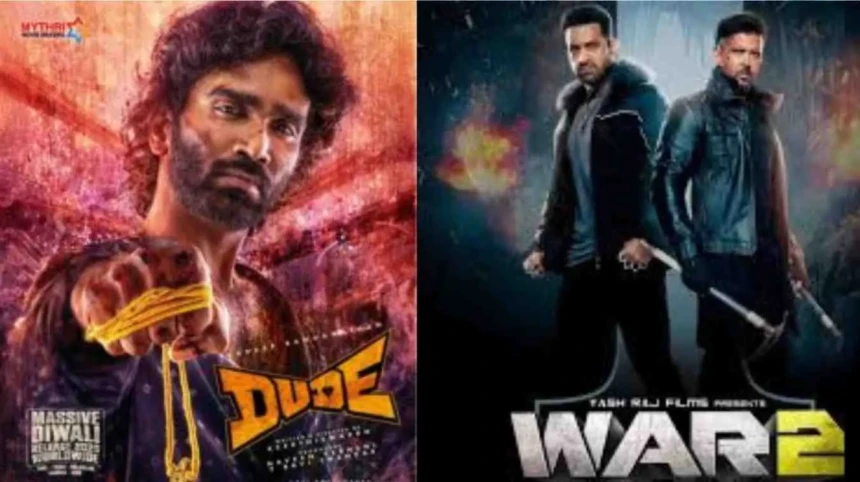
While Kantara dominates current box office charts, another contender is waiting in the wings—Dude. Directed and headlined by Pradeep Ranganathan, the film has officially received clearance from the Central Board of Film Certification (CBFC) with a U/A certificate.
Running for 139 minutes, the film is positioned as a pan-Indian entertainer with an intense cast ensemble. The trailer, released today (October 9), has already generated a flurry of excitement, positioning the film as one of the Diwali season’s biggest releases (slated for October 17).
Trade analysts predict Dude could potentially capitalize on the festive box office rush. With its fresh storytelling style and Ranganathan’s growing fan base, the film stands poised to challenge other holiday releases, adding healthy competition to an already crowded October slate.
War 2 Debuts on Netflix: Expanding the Spy Universe
For fans of Bollywood’s action spectacle, October 9 marks a new chapter as Yash Raj Films’ War 2 begins streaming on Netflix. Starring Hrithik Roshan and Jr NTR, the film is part of YRF’s ambitious “Spy Universe,” which has already delivered blockbusters like Pathaan and Tiger 3.
The OTT release is particularly significant as it marks Jr NTR’s grand Bollywood entry, which drew huge attention during its theatrical release. His pairing with Hrithik Roshan added an electrifying star factor, and the Netflix debut now ensures the film will reach global audiences, expanding its cultural footprint beyond Indian borders.
OTT platforms like Netflix are proving crucial in shaping the second life of major films. As cinema lovers in smaller towns and international markets tune in, War 2 is expected to add significantly to its already impressive revenue tally.
Global Horizons: Yash Raj Films to Shoot Three Movies in the UK
Indian cinema’s global march got an official stamp of approval as the UK Prime Minister announced that Yash Raj Films will shoot three major Bollywood projects in Britain starting 2026. The collaboration is not just about cinematic storytelling but also about economic and cultural diplomacy.
According to estimates, the move will create nearly 3,000 jobs in the UK, enhancing production synergies between Bollywood and Britain. More importantly, it signals Bollywood’s increasing ambition to position itself as a global soft power industry.
For YRF, which has long been known for lavish international shoots (Switzerland in the ’90s, Europe in the 2000s), this marks a continuation of tradition, but with a modern, cross-border collaborative twist. Audiences can expect stories that resonate not just with Indian viewers but also appeal to a broader global demographic.
The AI Debate: Bollywood & Hollywood Push for Copyright Protection
Even as films dominate the box office and OTT platforms, the industry is grappling with a very different challenge—Artificial Intelligence. On October 9, news emerged that both Bollywood and Hollywood groups have jointly lobbied an Indian regulatory panel for AI-proof copyright laws.
The concern is simple yet alarming: AI models today can ingest copyrighted material—film scripts, visuals, or even entire performances—and generate new outputs without legal repercussions. For filmmakers, this poses a grave threat to intellectual property, creativity, and revenue.
Industry insiders argue that unless the Indian Copyright Act is updated to address AI-related exploitation, the creative economy could suffer significant losses. The lobbying effort is thus seen as a proactive step to ensure that AI supports creativity rather than replaces it.
YouTube Cracks Down on AI-Generated Bollywood Videos
The AI debate is not theoretical—it’s already unfolding in real time. Following a Reuters exposé, YouTube has removed hundreds of AI-generated Bollywood videos that manipulated or misrepresented popular stars.
Some of these deepfake-style videos featured fabricated interactions between celebrities like Abhishek Bachchan and Aishwarya Rai, raising concerns about digital ethics and identity theft. The affected actors have reportedly filed lawsuits, underscoring how technology can distort reputations and personal rights.
The takedown is part of YouTube’s broader crackdown on AI-generated harmful content. But it also highlights a pressing issue: the fine line between creativity, parody, and harmful misinformation in the age of AI tools.
Celebrity Buzz: Aryan Khan & Raghav Juyal
Not all headlines today were about box office numbers and legal battles. On the lighter side, actor-dancer Raghav Juyal revealed details about his friendship with Aryan Khan, son of superstar Shah Rukh Khan.
According to Juyal, Aryan has a unique “technique”—he behaves extremely sanskari (respectful and well-mannered) in front of mothers, which helps him win hearts effortlessly. The playful remark quickly trended on social media, adding a touch of humor and relatability to the otherwise serious news cycle.
Box Office Struggles: Sunny Sanskari Ki Tulsi Kumari
Not every release this season has turned into a blockbuster. Sunny Sanskari Ki Tulsi Kumari, starring Varun Dhawan and Janhvi Kapoor, is struggling to touch the ₹40 crore mark even after a week.
Despite promotional offers and attempts to boost ticket sales, the film lags behind comparable hits like Badrinath Ki Dulhania. Analysts suggest the film’s failure to connect emotionally with audiences has led to its underperformance, particularly when stacked against cultural juggernauts like Kantara.
This contrast between runaway hits and struggling ventures illustrates the current Indian audience’s no-compromise attitude toward storytelling.
October 2025: A Packed Release Calendar
October is turning out to be one of the busiest months in recent Bollywood history. With Kantara ruling the box office, Dude gearing up for release, and War 2 debuting on Netflix, the month already feels like a cinematic festival.
But the lineup doesn’t end there—upcoming releases like Go Goa Gone 2 and Thamma promise to keep audiences hooked throughout the festive season. Industry watchers believe October 2025 could set new benchmarks for theatrical revenue and streaming numbers combined.
Conclusion: A Snapshot of Indian Cinema’s Present & Future
October 9, 2025, offers a fascinating glimpse into the evolving landscape of Indian cinema. On one hand, rooted films like Kantara are rewriting box office history, proving that authentic storytelling can transcend language and geography. On the other, new projects like Dude reflect the ambition of young filmmakers to challenge traditional norms.
Meanwhile, OTT platforms are ensuring that cinematic experiences reach every corner of the globe, as evidenced by War 2’s Netflix release. Simultaneously, international collaborations like YRF’s UK venture show that Indian cinema is increasingly a global enterprise.
Yet, amid all this progress, the AI controversy reminds us of the fragility of intellectual property in the digital age. The industry’s push for stronger copyright laws and the takedown of deepfake videos underline the urgent need for responsible technological integration.
In essence, October 9 was not just a day of headlines—it was a microcosm of Indian cinema’s journey: deeply rooted, globally ambitious, technologically challenged, and culturally vibrant. If today is any indication, the future of Indian cinema will be shaped by its ability to balance tradition with innovation, creativity with responsibility, and entertainment with ethics.