
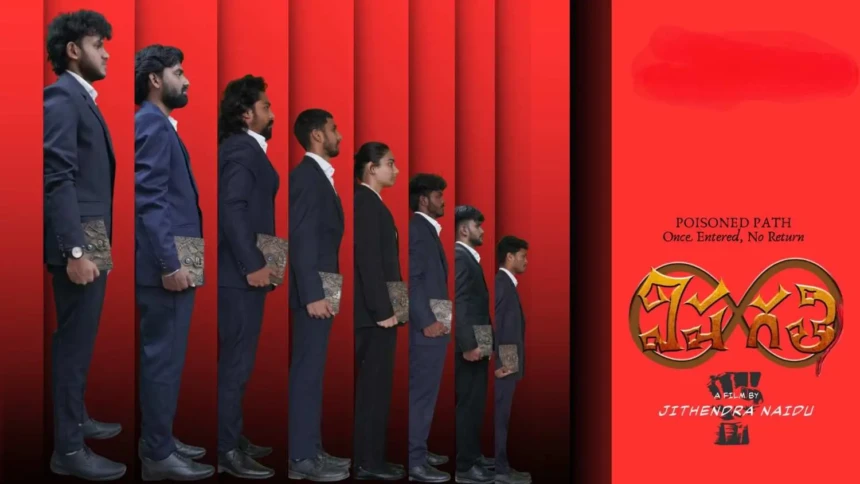
In the world of independent cinema, where resources are often limited but passion burns brighter than obstacles, one name is silently making waves — Jithendra Naidu Boya, fondly known among his peers as Jitthu. His latest Telugu sci-fi thriller Visha Gati has become a talking point among indie film audiences after its release on Filminity, a fast-growing OTT platform celebrated for promoting authentic, low-budget, and experimental storytelling.
What began as an experimental idea by a college student has now transformed into a full-fledged short film that’s gaining wide appreciation for its originality, message, and the sheer sincerity behind its making. Visha Gati explores a world where human choices intersect with technology, morality, and illusion — blurring the line between reality and deception. The narrative presents an emotionally intense take on addiction, temptation, and the irreversible paths humans choose when led by curiosity or vice.
A Film Born from Curiosity and Concern
Before the journey of Visha Gati began, director Jithendra Naidu Boya found inspiration from an unexpected moment during his 2nd year of B.Tech. One random day, while scrolling through YouTube, he came across a video that instantly caught his curiosity. The video portrayed simple human activities like walking, running, and talking — but the humans were replaced by robots. Their movements, gestures, and the realistic backgrounds amazed him. Though it wasn’t a perfect replication, it looked fascinating enough to spark a creative idea. Jithendra thought of incorporating such AI tools into his next short film to bring a unique, experimental feel to it. That’s where the seed for Visha Gati was first planted.
At the same time, another strong emotion began shaping the concept. Studying at one of the reputed universities, Jithendra witnessed a troubling reality around him students falling into the traps of drug addiction and physical pleasures. Despite being aware of their consequences, many of them continued on that path, including some of his close friends. Seeing that environment disturbed him deeply. He tried to guide his friends to choose better paths, but many couldn’t escape those habits. This harsh truth struck him emotionally.
Jithendra decided to merge these two contrasting ideas the futuristic world of AI and the dark reality of student addiction into one gripping narrative. He wanted to portray how drug mafias and substance abuse quietly destroy lives, careers, and relationships while people remain unaware of their downfall.
Over the next one and a half to two years, Jithendra kept refining his ideas. During this period, he also made one short film and two documentaries, continuously improving his craft. Each time a new idea struck him, he added it to the developing story of Visha Gati.
In February 2025, he narrated the almost complete story to his friend Bhagath. That was when Jithendra realised the strength of his concept — it was fresh, meaningful, and socially relevant. However, he decided to enhance it further by adding sequences that reveal how addiction operates like a silent poison — corrupting not just individuals but entire systems.
After dedicating around 40 to 50 days to rewriting and finalising the script, the film finally went on floors. The first shoot of “Visha Gati” began on April 5th, 2025.
Thus began the journey of Visha Gati — a film born from curiosity about technology and driven by a deep concern for the moral and mental decay of modern youth.
It stands as a reflection of today’s generation — where artificial intelligence meets real-life addiction, revealing the hidden battles of human consciousness in a world moving faster than ever before.
Crafted by a Student, Shaped by Purpose
The filmmaking process itself mirrors the grit of a young mind unwilling to give up. As a computer science student with no filmmaking background, Jithendra taught himself writing, cinematography, and editing by observing tutorials and experimenting with basic equipment.
He openly admits that academics never gave him joy, but movies did. “During school, I dreamed of becoming an IAS officer to serve my region, Kurnool,” he says. “But over time, I realized creativity can reach people’s hearts in ways positions can’t.”
His college days at LPU became the foundation for his cinematic vision. Surrounded by national and international students, he developed a newfound respect for cinema’s unifying power. When films like RRR won international acclaim, his admiration for director S. S. Rajamouli fueled his drive even more. “That victory taught me how far passion and persistence can go,” Jithendra says.
Team Spirit Beyond Professionalism
The Visha Gati cast and crew were entirely made up of students — young, enthusiastic, and mostly first-time actors. They were bound not by contracts, but by friendship and creative excitement. One of the film’s leads, Bhagath, describes working with Jithendra as rigorous and rewarding:
“Jitthu is like a soldier on set. Once he commits to something, he doesn’t stop until he gets the output he wants,” Bhagath shares. “Even when he was facing health and financial problems, his determination never dropped. We all worked out of brotherhood, not business.”
Another co-actor, Nakka Koushik (Kowboy), notes how emotionally intense the shoot became, especially for scenes involving smoking and drug use. “I don’t smoke in real life. The director gave me herbal cigarettes, but it was still physically tough. I even vomited once during a take,” he says. “But the final applause made everything worth it.”
For Chaitanya, one of the supporting actors, the experience was a revelation. Initially hesitant to participate, he ended up discovering his own potential on camera. “Jitthu was very particular about every shot and expression. We used to call him ‘Junior Rajamouli’ because of his obsession with detail,” Chaitanya recalls with a smile.
From Challenges to Milestones
Bringing Visha Gati to life was no easy task. The film was shot across various locations — from LPU’s sprawling university campus to nearby farms and even a railway track 10 km away from college.
Then came one of the most testing interruptions: the Sindoor war, which caused a campus-wide evacuation. With power cuts and red alerts across the region, filming came to a complete halt for weeks. When classes resumed, Jithendra had to reassemble his team, only to realize that two key actors had graduated and left for home. “I couldn’t delete their scenes out of respect,” he says. “So I rewrote portions of the script to close their arcs naturally.”
By the time the shoot concluded in late September 2025, the film had already demanded sleepless nights, physical exhaustion, and deep financial sacrifice. Jithendra confesses that his entire project ran on ₹25,000, most of it self-financed. At one point, a friend’s betrayal cost him ₹12,000 — nearly half his savings. “Some days I skipped meals to save money,” he says, remembering the mental struggle.
Even dubbing and post-production turned into lessons in resourcefulness. Without access to a studio, he converted his hostel room into a makeshift sound booth. “Some days, I felt shooting was easier than dubbing,” he laughs. “My ears hurt after recording 20 voices and guiding each actor through their lines.”
Despite all the hurdles, Visha Gati was completed and released on October 10, 2025 — chosen symbolically to coincide with S. S. Rajamouli’s birthday. “It was my tribute to the man who ignited my dream,” says Jithendra.
The Experimental Core of Visha Gati
Every frame of Visha Gati carries the imprint of ingenuity. With minimal tools and no external crew, Jithendra handled everything — scriptwriting, direction, editing, cinematography, props, and design.
He sought inspiration in intricate details: a specially designed book filled with hand-drawn diagrams, each sketched after weeks of collaboration with a campus artist; fake currency notes, hand-soaked in muddy water for a realistic texture; and “drug” props made from a harmless mix of cornflour and chocolate powder — a clever and safe artistic compromise.
To capture fatigue or fear authentically, he often asked actors to run or skip meals before takes. Lighting was improvised using natural sunlight and available sources, lending a raw texture to the visuals. For music, he sourced background tracks from paid libraries, manually syncing cues scene by scene. “Sometimes the perfect track transformed a moment,” he says. “But when I couldn’t find one, it broke my heart to cut the scene.”
Recognition and Reach through Filminity
When Visha Gati premiered on Filminity, its authenticity resonated instantly with viewers. The platform, known for nurturing independent voices, offered the perfect home for Jithendra’s self-made vision.
One week after release, messages of appreciation flooded in from students, filmmakers, and even strangers from other states. “I was amazed when meme pages and film portals shared my clips voluntarily,” he says. “I didn’t even ask them to promote it. That’s the power of honest art.”
Although the project hasn’t yet picked up formal awards, the reception on Filminity’s platform — marked by thousands of organic viewers and heartfelt responses — made Jithendra feel recognized in ways that trophies can’t. “Some people who once mocked my passion now tell me they admire my dedication,” he says. “That means everything.”
Filminity’s Role in Independent Voices
Filminity, continuing its mission of amplifying local and emerging storytellers, has been spotlighting young filmmakers like Jithendra who push creative and technical boundaries despite constraints. By streaming Visha Gati, the platform has made this powerful Telugu sci-fi short accessible to a wider audience, supporting the kind of courage-driven art that often goes unseen.
The platform’s executives have noted how stories like Visha Gati reflect the raw energy and experimentation that modern India’s youth are bringing into cinema. It is through platforms like Filminity that such honest, unfiltered stories find their true audience — a digital stage for creators who build not with budgets, but with belief.
The Message Behind the Title
At its essence, Visha Gati carries a moral warning that transcends its fictional scope. The title itself — meaning “slow poison” — symbolizes addiction’s deceptive grip. As Jithendra summarizes: “Once you fall into this poisonous path, it drags you down forever. Recovery becomes an illusion.” Through this striking metaphor, the film urges the youth to say no to drugs and remain vigilant about their choices.
Looking Ahead: Stories Waiting to Bloom
Riding on the success of Visha Gati on Filminity, Jithendra is already planning his next set of projects. His upcoming short, Comrade, will focus on a classical dancer’s artistic journey — merging tradition with emotional storytelling. Alongside this, he is developing modular scripts exploring diverse human experiences: trauma, love, personal loss, and resilience.
Beyond shorts, his long-term ambition includes feature-length ideas that experiment with narrative structures. Among them is a deeply emotional screenplay about a young man wrongly sentenced by his own mother, a judge unaware of his sacrifice — a concept already generating curiosity within his circle.
A Voice for Dreamers
In closing, Jithendra’s message for aspiring independent filmmakers carries weight born from experience:
“Come out of your comfort zone. Don’t wait for budget or team. Write for what you have, not what you dream of having. Even if fifty people ignore your first work, one person will notice your honesty. That’s enough to move forward.”
As Visha Gati continues streaming on Filminity, its story stands not only as a dark cautionary tale for today’s youth but also as a glowing testament to what one determined student can achieve with willpower, patience, and art.
Through struggle, loss, and solitary effort, Jithendra Naidu Boya has shown that cinema isn’t always about spectacle — sometimes, it’s about sincerity. And thanks to Filminity, that sincerity now has an audience as wide as the filmmaker’s dreams.