

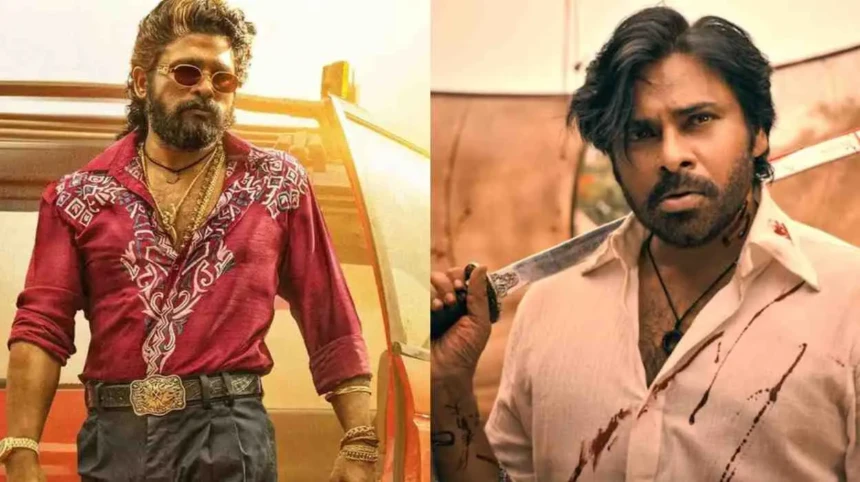
Atlee’s Next Big Bet: AA22 × A6 with Allu Arjun and Deepika Padukone
In the wake of Kantara’s triumph, filmmaker Atlee is gearing up for a project that could become the next cinematic earthquake. His upcoming film — tentatively titled AA22 × A6 — brings together two of India’s biggest stars: Allu Arjun and Deepika Padukone.
Atlee, known for turning mass entertainers into cultural events, describes the film as “a visual spectacle that will be addictive to watch.” Insiders hint that it combines the grit of Jawan with the stylish ferocity of Pushpa.
The choice of cast is telling. Allu Arjun bridges Telugu cinema’s raw energy with pan-India charisma, while Deepika Padukone embodies global elegance and emotional gravitas. Together, they form a duo that could blur the traditional North-South divide in Indian film audiences.
If executed well, AA22 × A6 could represent the evolution of the true pan-India film — not one that merely translates across languages, but one that genuinely unites diverse audiences through universal themes of ambition, rebellion, and spectacle.
They Call Him OG — Pawan Kalyan’s Gangster Epic Roars Past ₹190 Crore
Another story dominating October headlines is the unstoppable run of Pawan Kalyan’s They Call Him OG, which has now crossed ₹190 crore in 17 days. The film added ₹1.47 crore on its 17th day, defying predictions of a steep drop after its opening weekend.
Directed by Sujeeth, OG is a stylized gangster drama drenched in political undertones — a perfect vehicle for Kalyan’s larger-than-life screen persona. For fans, it’s not merely entertainment but an extension of his identity as both actor and politician.
The movie’s success also reflects the growing appetite for gritty, male-driven action dramas that combine cinematic craft with mythic heroism. Yet beyond the box-office numbers lies a deeper signal: regional star systems are no longer local phenomena — they are national forces.
Laapataa Ladies: From Modest Beginnings to Giant Awards Haul
It’s rare for a film with a modest production footprint to dominate the awards circuit. But Laapataa Ladies has done just that. At the 70th Filmfare Awards (2025), the film clinched a commanding 13 awards, including Best Film, Best Director (Kiran Rao), and several major technical and performance categories.
What makes this achievement more striking is that Laapataa Ladies became the film with the most nominations in Filmfare history — 24 nods. Among its honors:
- Best Supporting Actress went to Chhaya Kadam for her role in Laapataa Ladies.
- The Filmfare Critics’ Award for Best Actress was awarded to Pratibha Ranta for her work in Laapataa Ladies.
Earlier in 2025, the film also swept the IIFA Awards, bagging 10 trophies including Best Film, Best Director, Best Actress, and more.
The film’s triumph is more than a trophy haul — it’s a vindication of subtle storytelling, emotional depth, and the power of female-centric narratives in Hindi cinema.
🎭 Story & Impact: Why Laapataa Ladies Resonates
A Tale of Mistaken Identity Meets Social Observation
Laapataa Ladies (2024) is a remarkable drama woven around a deceptively simple premise: two newlywed brides, both veiled, end up swapped during a train journey, triggering confusion, identity crisis, and deeper reflections on gender, patriarchy, and autonomy.
Director Kiran Rao, co-producer with Aamir Khan, taps into rural landscapes, behavioral realism, and the emotional stakes beneath everyday life. The screenplay and dialogues, by Sneha Desai, earn special praise for their restrained power — handling conflict without melodrama.
Though the film was India’s official entry for the 97th Academy Awards, it didn’t secure a nomination. That in itself became part of the discourse — how such quietly potent films struggle in Oscar circuits compared to louder, more stereotyped submissions.
Box Office & Budget Notes
With a relatively modest budget (reportedly ~₹5 crore), Laapataa Ladies grossed lifetime collections nearing ₹25 crore — a strong return considering limited promotional muscle. Its path was never about mass action or star spectacle — but resonance and sustainability.
Release Choices & OTT Strategy
Aamir Khan, one of the producers, later admitted that Laapataa Ladies might have fared better at the box office had it remained longer in theaters before shifting to OTT. He argued the film’s word-of-mouth was strong enough to sustain theatrical momentum.
This touches a larger dilemma in today’s industry — when to move to OTT, and whether early streaming undermines theatrical potential. Laapataa Ladies became a case study in balancing reach and revenue.
National Pride: Vijay Kumar Arora Wins His Second National Award
While box-office records capture headlines, artistry found its due recognition this week too. Punjabi filmmaker Vijay Kumar Arora won his second National Award for Godday Godday Chaa, a heartfelt drama exploring women’s empowerment within the cultural fabric of Punjab.
The film’s success underscores how regional cinema continues to evolve as both an artistic and social voice. Where earlier Punjabi cinema was often dismissed as light-hearted or music-centric, Godday Godday Chaa proves that the industry can deliver profound narratives with cultural sensitivity and cinematic grace.
Arora’s win contributes to a growing list of filmmakers using regional platforms to explore universal human experiences — a trend mirrored in Tamil, Marathi, and Malayalam industries.
Idli Kadai and the Steady March of Tamil Cinema
Meanwhile, Tamil cinema is experiencing a quieter but equally strong resurgence. Dhanush’s directorial venture Idli Kadai has earned ₹46.6 crore domestically by its 11th day, a testament to his dual strength as storyteller and star.
The film’s second-Saturday collection of ₹1.50 crore reflects sustained audience interest — particularly in smaller towns and Tier-2 cities where word of mouth remains the most powerful marketing tool.
With Idli Kadai, Dhanush reaffirms his belief in content-driven cinema. By blending humor, emotion, and commentary on urban isolation, he creates a dish that tastes both nostalgic and fresh.
This consistent performance shows that theatrical releases remain robust despite the OTT onslaught. Audiences continue to crave the communal energy of cinema halls when the story connects.
The UK-India Connection: Global Stage for Bollywood
Beyond box-office and awards, the week also carried significant news on the international front. The British Prime Minister announced that three major Bollywood films will be shot in the United Kingdom starting in 2026, under a new India-UK creative partnership.
This initiative strengthens cross-border cultural exchange and aims to position the UK as a filmmaking hub for Indian producers. With tax incentives, high-tech studios, and globally trained crews, the UK is becoming an attractive location for Indian cinema’s international ambitions.
The partnership signals a new era of “globalized Indian storytelling.” As audiences worldwide become more receptive to subtitled and dubbed content, producers are looking outward — aiming to craft stories that travel beyond linguistic or national boundaries.
Conversations That Matter: Work Culture, Censorship, and AI
While films dazzled audiences, the industry engaged in introspection. Three major debates dominated social media and entertainment columns this week.
The 8-Hour Workday Debate
Deepika Padukone recently advocated for an 8-hour standard workday on film sets — a call for structured, humane working conditions. Actress Priyamani responded thoughtfully, calling the idea “subjective,” noting that filmmaking often demands flexibility and long hours.
This exchange reignited long-standing conversations about labor ethics in Indian cinema. With rising professionalism, digital scheduling, and unionization, the industry may be inching toward more balanced work practices — though implementation remains a challenge.
Censorship Crossroads
Veteran writer-lyricist Javed Akhtar stirred another debate when he criticized the censor board’s inconsistent standards: “Films with vulgarity get clearance, but those reflecting reality face hurdles.”
His statement captures the tension between creative expression and moral policing — a struggle as old as Indian cinema itself. As filmmakers explore darker, more socially relevant themes, regulatory frameworks will need rethinking to avoid stifling authenticity.
AI and Copyright Battles
In an age when artificial intelligence can generate screenplays and mimic performances, both Hollywood and Bollywood unions are pressing for stricter copyright safeguards.
Lobby groups have urged the Indian government to establish clear AI content-use policies — ensuring that machine learning models cannot train on copyrighted film material without licensing. This move mirrors global trends, where artists are fighting for digital ownership and ethical technology usage.
Together, these debates reflect a film industry in transition — not just technologically, but philosophically.
The Return of Theatrical Experience
Even as streaming giants dominate living rooms, cinema halls are regaining their magic. The ongoing success of Kantara, OG, and Idli Kadai proves that audiences crave spectacle, emotion, and community.
During the pandemic years, the narrative suggested that theaters might fade into nostalgia. But post-2023, Indian audiences demonstrated an enduring passion for big-screen storytelling. The “event cinema” model — where every film becomes a celebration — has revived footfalls across multiplexes and single screens alike.
Interestingly, the rise of regional theatrical hits coincides with a decline in star-only vehicles. Audiences now expect layered narratives, cultural specificity, and strong performances — values that regional filmmakers have long prioritized.
The Rise of Regional Powerhouses
A decade ago, Bollywood dictated the national conversation. Today, Indian cinema is polyphonic — a chorus of voices from Bengaluru, Hyderabad, Chennai, Kochi, and Chandigarh shaping the mainstream.
- Kannada cinema boasts the mythic realism of Kantara.
- Telugu cinema drives scale with RRR-style spectacle and OG-like grit.
- Tamil cinema sustains artistry through directors like Dhanush, Lokesh Kanagaraj, and Vetrimaaran.
- Punjabi and Marathi films explore social themes with authenticity.
This decentralization is healthy. It democratizes storytelling and diversifies India’s cinematic identity. Instead of a single “Bollywood brand,” the world now sees an ecosystem of vibrant sub-industries, each with distinct voices.
The Bigger Picture: Cinema as India’s Cultural Soft Power
As India strengthens its global presence, cinema continues to be one of its most powerful ambassadors. The collaboration with the UK, the global success of films like Kantara, and the rising influence of stars like Allu Arjun and Deepika Padukone underline this trend.
Streaming platforms have further accelerated this soft-power expansion. A viewer in Brazil can now binge Asur, Kantara, or RRR dubbed in Portuguese. A student in Seoul might stumble upon Laapataa Ladies on Netflix and fall in love with its small-town humor.
The result: Indian cinema is no longer “foreign” entertainment — it’s global content with emotional universality.
The Week in Retrospect
When the dust of October 12 settles, what remains most striking is the balance between celebration and reflection.
- Celebration — because films like Kantara and OG prove that passionate storytelling still reigns supreme.
- Reflection — because debates on ethics, censorship, and AI remind us that cinema is more than escapism; it’s a mirror of society.
In the grand frame, every piece of this week’s news — from Vijay Kumar Arora’s award to Atlee’s next collaboration — feels interconnected. Together, they signal a film industry unafraid of reinvention.
Conclusion: The Future Is Multiplex and Multilingual
If 2023 was the year of comeback and 2024 the year of experimentation, then 2025 is shaping up to be the year of integration — where artistry, commerce, and conscience align.
Indian cinema is no longer defined by geography or language; it is defined by vision. Whether it’s a Kannada director reviving ancient rituals, a Tamil actor-director making social satire, a Telugu superstar breaking records, or a Bollywood queen demanding fair work hours — the narrative remains one of courage and change.
As the world watches, Indian cinema’s evolution mirrors India itself: diverse, dynamic, and daring.
The lights dim, the reels roll, and the applause grows louder — because in 2025, the movie is far from over.






Haha, so apparently, Indian cinema is now a global powerhouse, judging by all the awards, box office hits, and even films getting made in the UK! Its wonderful to see regional cinema rising like never before, with films like *Kantara* and *Laapataa Ladies* proving that substance and artistry can indeed triumph. But lets be real, while we celebrate the 8-hour workday debate and fight for AI copyright, maybe we shouldnt forget the simple joy of a good film, whether its in a multiplex or on OTT, avoiding the event cinema fatigue, I say! 🎬🤷♂️ai remove watermarks